Dancing Cats 2: Music Games
- 4.4
- Rating
- 10.00M
- Installs
- Free
- Price

 Analysis by App-foxy
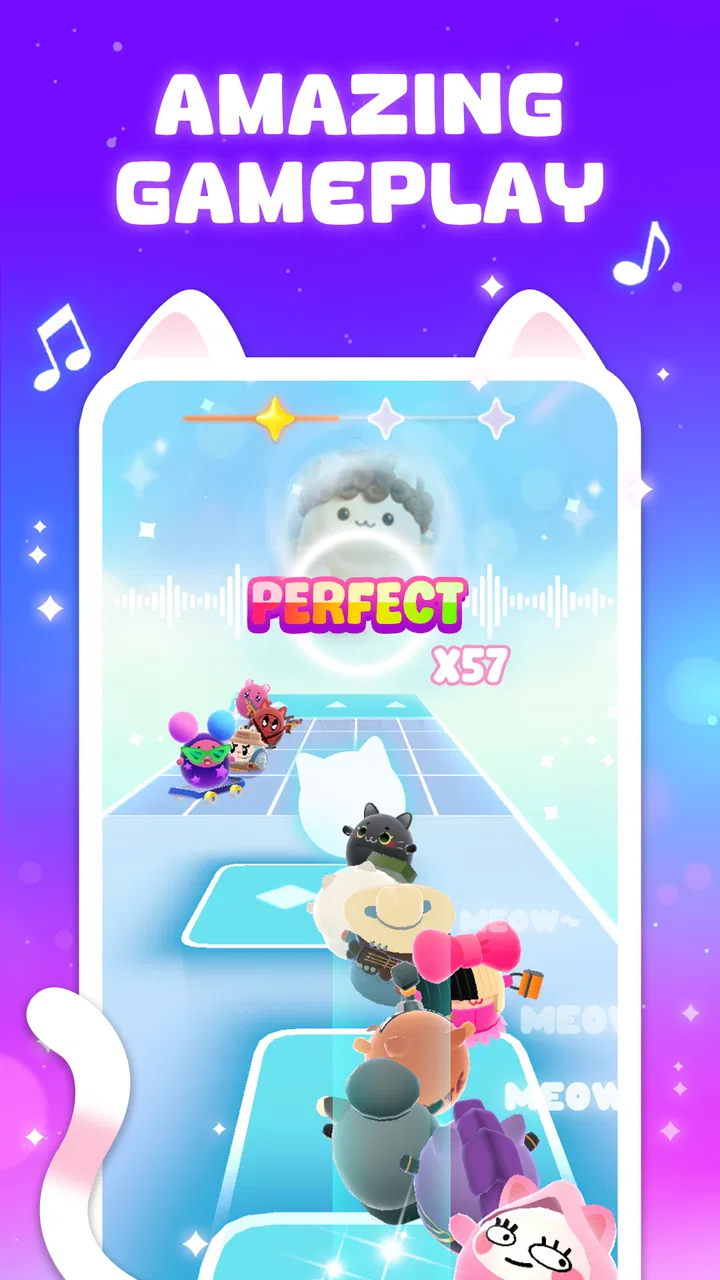
I approached Dancing Cats 2: Music Games as a quick music game rather than a serious rhythm-training tool, and that distinction matters. The appeal is immediate: tap along with piano-style songs while cheerful cat tiles move across the screen. It is easy to understand, friendly in tone, and suitable for casual play, but its real value depends on how comfortable you are with fast visual timing and repeated taps.
This is a free music game from Cobby Labs, listed for Everyone and available on Android devices running version 6.0 or later. Its average rating is 4.5 from around 5.9K ratings, and it has passed one million installs, so it has clearly found an audience beyond a small group of rhythm-game fans. The current version is 0.2.4, and the game was released on September 17, 2025.
How the game feels to read and navigate
The strongest part of the experience is how quickly the basic idea becomes understandable. You do not need to study a complicated rulebook before playing. The cat-themed presentation gives the game a soft, playful identity, while the piano-song format makes the central action familiar to anyone who has tried a tile-tapping game before.
You May Also Like

 Google Keep - Notes and lists
Google Keep’s Quiet Growth Shows the Appeal of Simpler Notes
As mobile work gets busier, Google Keep keeps winning a simple contest: capture a thought quickly, find it later, and get on with the day.

 Blood Strike: 2.5 Anniversary
Blood Strike’s Loadouts Turn Every Drop Into a Tactical Gamble
A close look at Blood Strike’s custom loadouts: how fast access to signature weapons reshapes its battle royale rhythm, rewards preparation, and narrows the gap between fights.

 Pandora - Music & Podcasts
Pandora’s Music Is Easy to Start, but Harder to Recover
Pandora’s strength is its low-effort path from a seed to a station. Its weak spot is how much confidence it asks you to place in connection, setup, and quiet recovery.

 8 Ball Pool
 Is Built on Rivalries, Rematches, and Routine
A close look at the rivalries, rematches, shared routines, and unanswered safety questions that turn a quick pool match into a persistent mobile community.

 Samsung Music
’s Quiet Strength Is Playing What You Already Own
Its reach comes less from spectacle than from dependable access to a personal library. That simplicity is both the app’s strongest retention engine and its ceiling.

 AccuWeather: Weather Radar
AccuWeather Review: A Quick, Clear Forecast for Everyday Decisions
For everyday plans, the best forecast is the one you can understand quickly. AccuWeather makes rain timing, radar, and local conditions easy to act on, with a few trade-offs.
More From Our News Desk



That simplicity is useful for younger players, occasional players, and anyone who does not want to spend time learning a large menu system. I can imagine handing the phone to a friend and explaining the objective in a few seconds. The game’s visual theme also makes it feel less intimidating than a rhythm title built around intense neon effects or competitive terminology.
Readability is not only about recognizing the cats or the tiles. It is also about tracking the next action while listening to the music. In a rhythm game, the screen can become busy even when the controls are simple. I found that the cat styling helps with personality, but players who need very high contrast, larger visual targets, or more space between moving elements may find the presentation demanding during faster passages.
For a short session, the navigation feels best when I treat it as a focused activity: choose a song, settle my grip, and pay attention to the lane in front of me. It is less comfortable when I am trying to play while distracted by notifications, conversation, or movement around me. That is not unusual for this genre, but it is worth considering before expecting it to work as a completely effortless game.
A useful habit is to spend the first attempt observing the movement instead of chasing a high score. I use that opening run to learn the pace, notice whether my eyes prefer the upper or lower part of the screen, and decide whether headphones help me follow the beat. This makes the game more approachable for people who need a moment to process visual motion.
What the cat theme adds
The cat presentation is more than a decorative change from a standard piano game. It lowers the emotional pressure. Missing a tile feels like part of a cute arcade experience rather than a harsh musical test. That can make the game a better introduction for someone who normally avoids rhythm games because they expect them to be difficult or overly competitive.
At the same time, the theme will not solve every readability issue. Cute artwork can compete with functional information if the screen becomes visually crowded. Players with attention-related difficulties may prefer to reduce other distractions around them and play in short, deliberate bursts. I would not describe the game as universally easy to read, but I do think its friendly design gives beginners a more comfortable starting point than many serious rhythm alternatives.
Motor control, sound, and sensory comfort
The main physical demand is precise tapping at the right moment. That sounds simple, yet repeated timing can be tiring for anyone with limited dexterity, hand pain, tremors, or difficulty coordinating sight and touch. The game is most comfortable when I hold the device securely and use the fingers that let me react without covering too much of the play area.
One practical adjustment is to avoid gripping the phone too tightly. A tense hand makes small timing errors more likely, especially when the song speeds up. I also prefer placing the device on a stable surface during longer sessions. That reduces the need to support its weight and leaves my tapping hand more relaxed, although it may make the viewing angle less convenient.
Players who use one hand should test the game during a slower section before committing to longer play. A single-thumb approach can work for simple patterns, but it may become awkward when taps appear across a wider area. Someone with limited reach or reduced control in one hand may have a better experience using both hands, provided the screen size and posture allow it.
The music is central, but not everyone can rely on hearing the beat. If you have hearing loss, play in a noisy environment, or simply prefer low-volume gaming, visual timing becomes more important. I would treat the motion of the tiles as the primary guide and the piano track as reinforcement rather than depending on sound alone. That approach is also useful when playing in a shared room where loud audio would be disruptive.
On the other hand, players sensitive to repeated sounds or bright, animated visuals should choose their setting carefully. A quiet room and moderate screen brightness make the experience easier to control. I would avoid playing for too long in a dark room, not because the game is inherently unsuitable, but because bright moving elements against darkness can become tiring faster than expected.
The most inclusive way to approach the game is to treat pace as a personal limit, not a challenge to ignore. Short sessions allow the player to stop before finger fatigue or sensory overload turns a pleasant game into an uncomfortable one. This is especially important for children, people with migraines, and anyone who finds repeated visual motion tiring.
Who is likely to enjoy the controls
This game is a natural fit for players who enjoy quick reactions, simple touch input, and music that gives a session its rhythm. It also works well for people who want a brief distraction while waiting for an appointment or taking a short break. The low entry barrier means a player does not need previous experience with rhythm games.
I would be more cautious recommending it to someone looking for relaxed, low-motion play. The cute cats may suggest a calm experience, but the tapping itself still requires concentration. Likewise, it is not the best choice for a player who wants to compose music, practice an instrument, or explore deep musical theory. The game uses music as the timing framework; it is not a substitute for a piano-learning app.
Playing in real-world situations
In everyday use, the game makes the most sense in short windows. Imagine sitting on a train with a few minutes available. You can play a song, stop when your destination approaches, and return later without needing to commit an entire evening. The same applies to a lunch break, although I would keep the volume low and avoid playing when I need to stay alert to announcements or people around me.
Travel introduces a few practical concerns. Movement can make accurate tapping harder, and glare may reduce the contrast between the screen and the tiles. If I were playing outdoors, I would position the phone to reduce reflections and choose a shorter session rather than trying to maintain a long streak. A stable seat is noticeably better than standing on a crowded platform.
The game can also work as a shared activity with a child or a friend. One person can tap while another listens for the beat or watches the cats. That makes the experience less isolating and can help a beginner understand the timing without feeling judged. Still, because the action depends on the player’s own reactions, it is not a fully cooperative game in the usual sense.
For parents, the Everyone rating makes the presentation broadly approachable, but I would still supervise younger children according to the family’s normal device habits. A child may enjoy the animals and music while becoming frustrated by missed taps. Turning the session into a few playful attempts rather than a demand for perfect performance keeps the experience healthier and more inclusive.
The free price is a meaningful advantage for trying it casually. You can see whether the visual pace and music style suit you without paying at the starting point. That also makes it easier to recommend to a friend who wants a simple game for an older Android phone, as long as the device meets the minimum operating-system requirement.
Players using iPhones or iPads should check the relevant platform availability before planning a download, because the experience can vary between mobile operating systems. On Android, the stated minimum is version 6.0. That requirement is relatively approachable for people using older compatible devices, although age alone does not guarantee that every phone will feel equally responsive.
Where the experience still creates barriers
The biggest barrier is the combination of speed and precision. Even with a simple interface, the game asks the player to process movement, predict timing, and tap accurately. That can exclude people who need slower input, larger targets, longer reaction windows, or a way to play without rapid repeated touches.
I would also like players to think about posture. Holding a phone close to the face may make small tiles easier to see, but it can strain the neck and shoulders. Holding it farther away improves posture for some people but may make details harder to follow. A stand can help balance those needs, especially for players who cannot comfortably hold a device for long periods.
Another limitation is situational rather than technical: the game needs attention. It is a poor match for multitasking while cooking, walking, supervising a hazardous activity, or crossing a street. Even if a song lasts only a short time, the timing mechanic can pull focus away from the environment. I recommend treating it like any other game that requires visual concentration.
Players with sensory sensitivities may need to experiment with brightness, volume, and session length. Since I cannot assume that every player experiences the animation or music in the same way, I would begin with a brief test and stop at the first sign of discomfort. A game that is enjoyable for ten minutes may not be comfortable for an hour, and there is no reason to force a longer session.
Compared with a traditional piano-tile game, this title stands out through its cats and approachable mood rather than through a more serious musical identity. Compared with a full rhythm game, it is easier to pick up but likely less suitable for someone seeking complex progression, deep customization, or a broad training system. A music-learning app is the better alternative for building real keyboard skills, while a slower puzzle game is better for players who want minimal reaction pressure.
That comparison helps define its audience. I see it as a casual arcade companion, not a replacement for a professional music tool or an accessibility-focused game with extensive control options. Its strength is the clean idea and inviting theme. Its weakness is that the same timing demand remains underneath the friendly artwork.
My inclusive verdict after playing
I recommend Dancing Cats 2: Music Games to people who want a free, cheerful rhythm game that can be understood quickly and enjoyed in short sessions. The cats give the familiar piano-tile formula a warmer personality, and the music-based tapping makes the game immediately engaging for players who like quick visual challenges.
I would recommend starting slowly, adjusting the phone’s position, and using the first few attempts to learn the visual flow instead of chasing perfect timing. Playing with moderate brightness and a comfortable grip can make a real difference. If sound is not practical, follow the tile movement visually and choose a quiet setting where concentration is easier.
I would skip it if you need a genuinely slow game, have difficulty with repeated rapid taps, or want an app that teaches piano technique. I would also choose something else when playing in a distracting or physically unstable environment. The Everyone rating and approachable presentation make it friendly, but they do not remove the motor and attention demands built into rhythm gameplay.
Overall, Cobby Labs has made a welcoming entry point into music games, with enough personality to stand apart from a plain tile-tapping clone. My opinion is positive but measured: it is best when used as a compact, playful challenge that respects the player’s limits. If that sounds like the kind of experience you want, the free download makes trying it a sensible choice.
FAQs for Dancing Cats 2: Music Games
01What is Dancing Cats 2: Music Games about?
Dancing Cats 2: Music Games is a rhythm-based mobile game where players guide adorable feline characters through a series of music-driven challenges. Players tap, swipe, and dance along to catchy tunes, unlocking new levels and customizing their cat avatars with unique outfits and accessories. It's a fun and engaging way to enjoy music and rhythm gaming.
02Is Dancing Cats 2 available for both Android and iOS?
Yes, Dancing Cats 2: Music Games is available for both Android and iOS devices. Users can download the game from the Google Play Store for Android or the Apple App Store for iOS, ensuring a wide range of compatibility across smartphones and tablets. Always check for the latest updates for optimal performance.
03Are there in-app purchases in Dancing Cats 2?
Yes, Dancing Cats 2 includes in-app purchases. Players have the option to buy additional content like new songs, outfits, and special power-ups. While the game can be enjoyed for free, these purchases can enhance the experience by offering customization and quicker progression through the game's levels.
04Can I play Dancing Cats 2 offline?
Dancing Cats 2: Music Games can be played offline, allowing users to enjoy the rhythm challenges without an internet connection. However, some features, such as downloading new songs or accessing online leaderboards, will require an internet connection. Offline play ensures that you can enjoy the game on the go.
05What age group is Dancing Cats 2 suitable for?
Dancing Cats 2 is suitable for a wide range of age groups, typically recommended for ages 4 and up. The game features colorful graphics, simple controls, and family-friendly music, making it accessible and enjoyable for both kids and adults. Parents can feel comfortable letting younger players engage with this fun and educational game.
Pros
- Engaging rhythm gameplay with cute cat animations.
- Variety of music tracks to keep you entertained.
- Intuitive controls perfect for quick play sessions.
- Offline mode available for on-the-go fun.
- Regular updates with new songs and features.
Cons
- In-app purchases can become pricey over time.
- Limited song selection without premium upgrade.
- Ads can interrupt gameplay at inconvenient times.
- Occasional lag on older devices.
- Requires stable internet for best experience.

Dancing Cats 2: Music Games
Gallery